There was a grading error on the yellow exam, so grades may have gone up a point.
The test was hard, but really only made a big difference on very borderline scores. Most of the time, the result was a grade that was close to moving up that did not advance. There were a few cases of students who were barely able to make a certain grade who lost it because of the final. I'm so sorry if this was you! Please consider coming in on Mondays next semester so we can keep those grades firm next time!!!
Period 5:
High score - 94
Low score - 45
Class average - 73.5
A - 5
B - 8
C - 9
D - 2
F - 9
Period 7:
High score - 97
Low score - 47
Class average - 73.52
A - 6
B - 6
C - 5
D - 10
F - 6
viernes, 17 de diciembre de 2010

martes, 14 de diciembre de 2010
14/12 - Final prep
1. Extra credit - in-class assignment to make flashcards for all the words on the Hard Words list.
2. Using little computers, do Jeopardy games to prepare for exam on Thursday/Friday.
La tarea: ESTUDIAR!
2. Using little computers, do Jeopardy games to prepare for exam on Thursday/Friday.
La tarea: ESTUDIAR!
viernes, 10 de diciembre de 2010
10/12 - more vocab, ser/estar practice, irregular verb jeopardy
1. Conferencing with students
2. I added some more words to the "Hard words" list from a few days ago. Unfortunately, I did not save the file and I forgot to bring the list home so if you were absent, come in on MONDAY and I can give you the list.
3. Ser/estar practice in workbook, p33
4. Jeopardy (the link to the game is posted in the links box on the right).
La tarea: STUDY for the FINAL! vocab, irregular verbs, ser/estar/tener and much, much more.
2. I added some more words to the "Hard words" list from a few days ago. Unfortunately, I did not save the file and I forgot to bring the list home so if you were absent, come in on MONDAY and I can give you the list.
3. Ser/estar practice in workbook, p33
4. Jeopardy (the link to the game is posted in the links box on the right).
La tarea: STUDY for the FINAL! vocab, irregular verbs, ser/estar/tener and much, much more.
9/12 - Independent study day and conferencing
1. Students were encouraged to do worksheets and practice for topics they are not familiar with
2. Individual conferences to determine grades needed for final. Will continue today
Keep on studying!!!!
2. Individual conferences to determine grades needed for final. Will continue today
Keep on studying!!!!
miércoles, 8 de diciembre de 2010
8/12 - Tener expressions, interrogatives, final exam review sheet
1. Students correct crosswords from yesterday.
2. Tener expressions practice, add 2 new ones.
3. Review sheet for final exam.
La tarea: study!!
2. Tener expressions practice, add 2 new ones.
3. Review sheet for final exam.
La tarea: study!!
martes, 7 de diciembre de 2010
7/12 - review - ser/estar/tener, saber/conocer, reflexives, irregular verbs
1. Review sheet, we went through it section by section to help determine which of the main topics you will need to study.
La tarea: finish irregular crossword puzzle.
La tarea: finish irregular crossword puzzle.
lunes, 6 de diciembre de 2010
New test question acknowledgements
I submitted the new questions for the final. Some had to be tweaked a little, and the other teachers still have a say, but Thank You to the following students:
Doni
Sam
Kayla M
Jamie
Cheyanne
Tori
Sara N
Karly
Raelena
Kimi, Sara, and Lilly
Taylor W
Jacob
Doni
Sam
Kayla M
Jamie
Cheyanne
Tori
Sara N
Karly
Raelena
Kimi, Sara, and Lilly
Taylor W
Jacob
sábado, 4 de diciembre de 2010
3/12 - Pen pal letters
1. Pen pal letters - from Wisconsin and Ohio. Everyone got a letter to answer! Answers are due Tuesday if you didn't turn it in in class.
2. per 7: Students made up 1-2 multiple choice questions for me to use on the final exam. I have selected which ones I'll use, but my questions are always at the mercy of the other Spanish 2 teachers, who can adapt and change my submissions.
La tarea: I would recommend working on the list of hardest words from the final exam. Next week we will review each grammatical topic from the test, but you need to study vocab on your own.
2. per 7: Students made up 1-2 multiple choice questions for me to use on the final exam. I have selected which ones I'll use, but my questions are always at the mercy of the other Spanish 2 teachers, who can adapt and change my submissions.
La tarea: I would recommend working on the list of hardest words from the final exam. Next week we will review each grammatical topic from the test, but you need to study vocab on your own.
jueves, 2 de diciembre de 2010
2/12 - Final review
1. I gave students a list of the (approx) 30 hardest words on the final. We also went over some "tener" expressions.
2. Q&A - questions you should remember how to answer from Spanish 1.
3. period 5: read and understand p. 85, Ad for "cortapelos"
4. period 7: lame game
La tarea: MEMORIZE the tener expressions you didn't already know (there should be 5 or 6).
2. Q&A - questions you should remember how to answer from Spanish 1.
3. period 5: read and understand p. 85, Ad for "cortapelos"
4. period 7: lame game
La tarea: MEMORIZE the tener expressions you didn't already know (there should be 5 or 6).
miércoles, 1 de diciembre de 2010
1/12 - Q&A, pen pal letters
1. Q&A with preterite (past) tense ?Que comiste en el almuerzo? (Yo comi ____)
2. Magazine - Realia
3. Packet of final review info, students who were missing sheets got the ones they needed.
4. Pen pal letters/Gender of nouns sheet. Turn in pen pal letter if done.
La tarea: Finish pen pal letter or Gender of nouns sheet
2. Magazine - Realia
3. Packet of final review info, students who were missing sheets got the ones they needed.
4. Pen pal letters/Gender of nouns sheet. Turn in pen pal letter if done.
La tarea: Finish pen pal letter or Gender of nouns sheet
martes, 30 de noviembre de 2010
30/11 - Free sample of preterite tense, read aloud
1. Answer question "?Adonde fuiste en el dia de gracias?" (Fui a .....) Preterite tense!!
2. Talk about speaking Spanish in real life.
3. Realia: Magazine ads for toothpaste and a soap opera
4. Readaloud: students took turn reading a sentence at a time. "El Baile"
5. Final exam check: students searched to see if they have the papers they will need to prepare for the final exam. I will copy pages for those who need them.
6. Pen pal letters from Holland! Read and understand, we will answer tomorrow.
La tarea: none!
2. Talk about speaking Spanish in real life.
3. Realia: Magazine ads for toothpaste and a soap opera
4. Readaloud: students took turn reading a sentence at a time. "El Baile"
5. Final exam check: students searched to see if they have the papers they will need to prepare for the final exam. I will copy pages for those who need them.
6. Pen pal letters from Holland! Read and understand, we will answer tomorrow.
La tarea: none!
sábado, 20 de noviembre de 2010
19/11 - Orals
1. Students played reflexive verb Battleship while Orals were taking place.
La tarea: If you havent' done your Oral, make sure to come in on Monday!!!!!!!!
Speak Spanish in your life!
La tarea: If you havent' done your Oral, make sure to come in on Monday!!!!!!!!
Speak Spanish in your life!
jueves, 18 de noviembre de 2010
18/11 - Orals/ reading
1. Notes: bring individual snacks for yourself to share with everyone tomorrow (33 students plus Sra!), homework over break is to use Spanish in your actual life.
2. Oral practice: Students read through their presentations, then tried to do it without a script. They performed the oral 5 times, one for each possible subject (yo, tu, el, nosotros, ellos). I told them that they need to finish in 5 minutes; if they can finish in less than 2 minutes, they get 3 points of extra credit. Of the 12 students who performed today, all but 2 got the extra credit. Students may use one retake, either after all the first-timers tomorrow or on Monday after break.
3. Reading, with a partner, read a short story in Spanish. Start answering questions in packet.
La tarea: prepare your oral presentation.
2. Oral practice: Students read through their presentations, then tried to do it without a script. They performed the oral 5 times, one for each possible subject (yo, tu, el, nosotros, ellos). I told them that they need to finish in 5 minutes; if they can finish in less than 2 minutes, they get 3 points of extra credit. Of the 12 students who performed today, all but 2 got the extra credit. Students may use one retake, either after all the first-timers tomorrow or on Monday after break.
3. Reading, with a partner, read a short story in Spanish. Start answering questions in packet.
La tarea: prepare your oral presentation.
miércoles, 17 de noviembre de 2010
17/11 - prepararse para la presentacion oral
1. Finish sentences
2. make pictures
3. Practice doing your presentation for different people.
La tarea: Prepare for the oral! I would recommend reading through your presentation, then trying to read it conjugated for other subjects:
yo
tu
el
nosotros
ellos
Once you've done it a few times, turn over your script and try to do it just looking at the pictures.
2. make pictures
3. Practice doing your presentation for different people.
La tarea: Prepare for the oral! I would recommend reading through your presentation, then trying to read it conjugated for other subjects:
yo
tu
el
nosotros
ellos
Once you've done it a few times, turn over your script and try to do it just looking at the pictures.
martes, 16 de noviembre de 2010
16/11 - ser/estar review, reflexive verbs
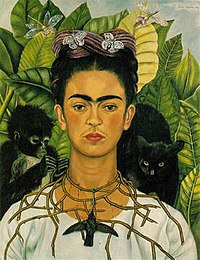
1. Ser/estar worksheet
2. Videos on reflexive verbs
3. Discuss oral presentation due Thurs/Fri/Mon after Thanksgiving.
4. Work on presentations with study groups.
La tarea: finish writing script.
(Frida self-portrait with monkeys!)
viernes, 12 de noviembre de 2010
11/12 - reflexives vs. non-reflexives
1. Gramactiva!
2. Text p.80, explains how to conjugate reflexive verbs as part of double verbs. With double verbs, you only conjugate the first verb, the second stays as an infinitive BUT if it has a reflexive pronoun, you still need to make that agree with the subject. The reflexive pronoun needs to be placed either before the conjugated verb or attached to the end of the infinitive. Por ejemplo: Yo voy a lavarme las manos antes de comer./Yo me voy a lavar las manos antes de comer.
3. Reflexive verbs can also be used non-reflexively. Think about the meaning of the sentence. Yo me lavo las manos is reflexive because I am washing my own hands. Yo lavo el coche is not reflexive because I wash the car.
4. Write out 10 reflexive activities you do in the morning with times. Por ejemplo: 6:00am Me despierto. 6:05am Me levanto.
La tarea: NONE
2. Text p.80, explains how to conjugate reflexive verbs as part of double verbs. With double verbs, you only conjugate the first verb, the second stays as an infinitive BUT if it has a reflexive pronoun, you still need to make that agree with the subject. The reflexive pronoun needs to be placed either before the conjugated verb or attached to the end of the infinitive. Por ejemplo: Yo voy a lavarme las manos antes de comer./Yo me voy a lavar las manos antes de comer.
3. Reflexive verbs can also be used non-reflexively. Think about the meaning of the sentence. Yo me lavo las manos is reflexive because I am washing my own hands. Yo lavo el coche is not reflexive because I wash the car.
4. Write out 10 reflexive activities you do in the morning with times. Por ejemplo: 6:00am Me despierto. 6:05am Me levanto.
La tarea: NONE
jueves, 11 de noviembre de 2010
11/11 - reflexives, expand on knowledge
1. Quiz retake
2. Esponja - reflexives
3. Vocab list expansion/1st 2 pages of packet
4. per7: p80 text -read about more use of reflexives.
La tarea: None!
2. Esponja - reflexives
3. Vocab list expansion/1st 2 pages of packet
4. per7: p80 text -read about more use of reflexives.
La tarea: None!
11/11 - -ar quiz retake, vocab list
1. -ar verb retake
2. esponja - vocab and verb "Hay" = there is/there are
3. Vocab practice, do flashcards, vocab bingo
La tarea: none!!
2. esponja - vocab and verb "Hay" = there is/there are
3. Vocab practice, do flashcards, vocab bingo
La tarea: none!!
miércoles, 10 de noviembre de 2010
10/11 - verbos reflexivos
1. per 7: finish esponja from yesterday.
2. Both classes: review of reflexive verbs and how to conjugate them. Remember ME TE SE NOS OS SE.
3. per 5: reflexive verb quiz
La tarea: per 7 prepare for the retake!!!
2. Both classes: review of reflexive verbs and how to conjugate them. Remember ME TE SE NOS OS SE.
3. per 5: reflexive verb quiz
La tarea: per 7 prepare for the retake!!!
martes, 9 de noviembre de 2010
11/9 - reflexive verbs, new pen pals, clothing game
I had planned to give a quiz today, but students had not prepared. Period 5 worked nicely through our activities and I agreed to let them wait until tomorrow for the quiz. It will be FIRST thing in the hour.
Period 7 however, was too noisy and not paying attention to the review. After shushing them several times, they had to take the quiz. They did not finish the esponja/review activity. They will do that tomorrow.
1. Students who were going to write to pen pals in Holland are going to be writing to a Spanish 2 class in Ohio instead. Yay! Students wrote a simple introductory letter today.
1. Students who have pen pals in Wisconsin wrote detailed descriptions of their clothes for a game later in the period.
2. Esponja - sort reflexive verbs by time of day and conjugation practice.
3. Read descriptions, if students can ID who it is, both students get candy.
Period 7 however, was too noisy and not paying attention to the review. After shushing them several times, they had to take the quiz. They did not finish the esponja/review activity. They will do that tomorrow.
1. Students who were going to write to pen pals in Holland are going to be writing to a Spanish 2 class in Ohio instead. Yay! Students wrote a simple introductory letter today.
1. Students who have pen pals in Wisconsin wrote detailed descriptions of their clothes for a game later in the period.
2. Esponja - sort reflexive verbs by time of day and conjugation practice.
3. Read descriptions, if students can ID who it is, both students get candy.
viernes, 5 de noviembre de 2010
11/5 - presentaciones orales
1. presentaciones orales
2. per 7 only: Finish the first page of the packet, and do the second page.
La tarea: STUDY VOCAB!!! Study the reflexive verbs (21 of them) for quiz on Tuesday. Feel free to come in and drill vocab on Monday!
2. per 7 only: Finish the first page of the packet, and do the second page.
La tarea: STUDY VOCAB!!! Study the reflexive verbs (21 of them) for quiz on Tuesday. Feel free to come in and drill vocab on Monday!
4/11 - Presentaciones orales, verbos reflexivos
1. Esponja - preguntas personales con verbos reflexivos
2. Presentaciones orals.
La tarea: None
2. Presentaciones orals.
La tarea: None
miércoles, 3 de noviembre de 2010
3/11 - verbos reflexivos, prepararnos para la presentacion oral
1. Esponja - describe 2 men
2. Explanation of reflexive verbs: textbook p.80
3. Using vocab list, we practiced conjugating reflexives.
4. Packet - section A on first page to practice new vocab and relexives.
La tarea: Prepare for the oral tomorrow or Friday!!!!
2. Explanation of reflexive verbs: textbook p.80
3. Using vocab list, we practiced conjugating reflexives.
4. Packet - section A on first page to practice new vocab and relexives.
La tarea: Prepare for the oral tomorrow or Friday!!!!
martes, 2 de noviembre de 2010
2/11 - Escribir cartas y presentaciones
1. Esponja
2. Grupos de estudio - los estudiantes tienen que trabajar con estos grupos para escribir y corregirse.
3. Cartas a los pen pals, Presentacion oral.
La tarea: Final pen pal letter due tomorrow.
Español 2 – La Ropa – Presentación Oral – jueves y viernes, el 4-5 de noviembre
Uds. van a describir sus calacas. Tienen que usar por lo menos 40 palabras diferentes que vienen de la lista de vocabulario (ropa, telas, diseño, otras partes de la ropa, colores). Van a leer sus presentaciones a la clase el jueves o el viernes (unas personas pueden hacer sus presentaciones el miércoles, si quieren).
La notas:
10 puntos - la presentación oral (tienen que pronunciar bien todas las palabras)
10 puntos - la parte escrita
5 puntos – marcar las palabras de la lista de vocabulario
5 puntos - prestar atención y aplaudir
Ej: Srta Calaca lleva una camisa blanca y amarilla a rayas. La camisa es de algodón y tiene botones azules y un bolsillo. (9 palabras)
Palabras útiles: es de = is made of (used with fabrics)
2. Grupos de estudio - los estudiantes tienen que trabajar con estos grupos para escribir y corregirse.
3. Cartas a los pen pals, Presentacion oral.
La tarea: Final pen pal letter due tomorrow.
Español 2 – La Ropa – Presentación Oral – jueves y viernes, el 4-5 de noviembre
Uds. van a describir sus calacas. Tienen que usar por lo menos 40 palabras diferentes que vienen de la lista de vocabulario (ropa, telas, diseño, otras partes de la ropa, colores). Van a leer sus presentaciones a la clase el jueves o el viernes (unas personas pueden hacer sus presentaciones el miércoles, si quieren).
La notas:
10 puntos - la presentación oral (tienen que pronunciar bien todas las palabras)
10 puntos - la parte escrita
5 puntos – marcar las palabras de la lista de vocabulario
5 puntos - prestar atención y aplaudir
Ej: Srta Calaca lleva una camisa blanca y amarilla a rayas. La camisa es de algodón y tiene botones azules y un bolsillo. (9 palabras)
Palabras útiles: es de = is made of (used with fabrics)
sábado, 30 de octubre de 2010
29/10 - Calacas vestidas
1. Read the rest of Day of the Dead book, this part had to do with the celebration of the holiday.
2. Discuss: Entrance tickets to retake on Monday.
3. Assignment: Dress your "calaca" in such a way as you can use 40 vocab words to decribe it. Vocab includes clothing items, clothing accessories (button, pocket), fabrics, designs, and colors. DO NOT do the description now, just bear in mind while you are dressing it that you will need to describe it too. It is okay to dress front and back.
La tarea: For Monday, do entrance tickets and prepare for retake.
For Tuesday, pen pal letter rough drafts for Wisconsin writers, completely and classroom-appropriately dressed skeleton for everyone.
2. Discuss: Entrance tickets to retake on Monday.
3. Assignment: Dress your "calaca" in such a way as you can use 40 vocab words to decribe it. Vocab includes clothing items, clothing accessories (button, pocket), fabrics, designs, and colors. DO NOT do the description now, just bear in mind while you are dressing it that you will need to describe it too. It is okay to dress front and back.
La tarea: For Monday, do entrance tickets and prepare for retake.
For Tuesday, pen pal letter rough drafts for Wisconsin writers, completely and classroom-appropriately dressed skeleton for everyone.
jueves, 28 de octubre de 2010
28/10 - Prueba de vocabulario
1. Practice quizzes
2. Quiz
3. Extra credit on quiz
4. Day of the Dead explanation - history and origins
5. New vocab - other side of vocab list, sections for "cosas que tienen que ver con la ropa" y "diseno."
6. Tomorrow: Cut out and dress a skeleton. Then, prepare a presentation of that skeleton for the class using at least 40 words from vocab list (ones from today and clothing, as well as colors). Oral presentations will be next week. No need to memorize, just read and pronounce well.
La tarea: NONE, except if you want to bring in any decorating stuff for the skeletons.
2. Quiz
3. Extra credit on quiz
4. Day of the Dead explanation - history and origins
5. New vocab - other side of vocab list, sections for "cosas que tienen que ver con la ropa" y "diseno."
6. Tomorrow: Cut out and dress a skeleton. Then, prepare a presentation of that skeleton for the class using at least 40 words from vocab list (ones from today and clothing, as well as colors). Oral presentations will be next week. No need to memorize, just read and pronounce well.
La tarea: NONE, except if you want to bring in any decorating stuff for the skeletons.
miércoles, 27 de octubre de 2010
27/10 - Vocab practice
1. Retake entrance tickets available. Students were allowed to pick up sheets for any sections they will retake on Monday. They must bring in a completed entrance ticket on Monday to retake that section. PLEASE bring in your entrance ticket this week for me to check to make sure you are learning what you need to learn to do better!!!!
2. Esponja: categorize clothing vocab
3. Bingo with vocab
4. Make practice quizzes
5. Pen pal letters from Wisconsin. Students need to bring in a rough draft of their response tomorrow.
5. Holland pen pals: students need to read the explanation about determining the gender of nouns (you can get the explanation here). Then do the pyramid puzzle on the back of the explantion.
La tarea: finish gender puzzle OR rough draft.
2. Esponja: categorize clothing vocab
3. Bingo with vocab
4. Make practice quizzes
5. Pen pal letters from Wisconsin. Students need to bring in a rough draft of their response tomorrow.
5. Holland pen pals: students need to read the explanation about determining the gender of nouns (you can get the explanation here). Then do the pyramid puzzle on the back of the explantion.
La tarea: finish gender puzzle OR rough draft.
martes, 26 de octubre de 2010
26/10 - La Ropa
1. Esponja - describe what people are wearing.
2. Go over tests, retake on Monday but students must bring "entrance ticket" to retake any and all sections they want. Entrance tickets will be announced tomorrow; students will do an activity to increase their understanding of the grammatical point they will retake. This will be turned in when entering for the retake.
3. Vocab practice with clothing
4. "Me gusta tu collar." "Gracias. Me gustan tus zapatos." "Gracias" Students complimented each others clothes.
Period 7: Find Sra. NOT DURING CLASSTIME tomorrow and compliment an item of her clothing for extra credit. This offer good for Wednesday only!
Period 5: You will have the same offer for Weds after school - Thursday.
La tarea: continue familiarizing yourself with the clothing vocab. Quiz on Thursday!
2. Go over tests, retake on Monday but students must bring "entrance ticket" to retake any and all sections they want. Entrance tickets will be announced tomorrow; students will do an activity to increase their understanding of the grammatical point they will retake. This will be turned in when entering for the retake.
3. Vocab practice with clothing
4. "Me gusta tu collar." "Gracias. Me gustan tus zapatos." "Gracias" Students complimented each others clothes.
Period 7: Find Sra. NOT DURING CLASSTIME tomorrow and compliment an item of her clothing for extra credit. This offer good for Wednesday only!
Period 5: You will have the same offer for Weds after school - Thursday.
La tarea: continue familiarizing yourself with the clothing vocab. Quiz on Thursday!
viernes, 22 de octubre de 2010
22/10 - Examen, vocabulario nuevo, Sugar Skull on Monday!
1. 1B Test
2. Start new vocab list. (If you were absent and want the list over the weekend, email me and I will send it to you mphipps@lps.k12.co.us)
3. Translate vocab for "La Ropa" (do not do the rest of the list now).
La tarea: Make flashcards for ALL "la ropa" vocabulario. Do English on one side and Spanish on the other for credit. Do pictures instead of/in addition to the English for extra credit (one extra homework assignment credit)
2. Start new vocab list. (If you were absent and want the list over the weekend, email me and I will send it to you mphipps@lps.k12.co.us)
3. Translate vocab for "La Ropa" (do not do the rest of the list now).
La tarea: Make flashcards for ALL "la ropa" vocabulario. Do English on one side and Spanish on the other for credit. Do pictures instead of/in addition to the English for extra credit (one extra homework assignment credit)
jueves, 21 de octubre de 2010
21/10 - last chance test prep, test tomorrow!
1. Check tarea
2. Esponja - comparisons
3. Go over tarea - comparisons, special attention to the uses of tan ___ como versus tantos/as ____ como. Tan is used with adjectives, tanto/a/s is used with nouns.
4. Packet p11 - practice with stem changing verbs, choosing the correct one and conjugating.
5. Packet p24 - tan ___ como practice
6. Packet p22 - Hace ___ que practice.
La tarea: STUDY FOR TEST, bring in supplies for sugar skull on Monday.
2. Esponja - comparisons
3. Go over tarea - comparisons, special attention to the uses of tan ___ como versus tantos/as ____ como. Tan is used with adjectives, tanto/a/s is used with nouns.
4. Packet p11 - practice with stem changing verbs, choosing the correct one and conjugating.
5. Packet p24 - tan ___ como practice
6. Packet p22 - Hace ___ que practice.
La tarea: STUDY FOR TEST, bring in supplies for sugar skull on Monday.
miércoles, 20 de octubre de 2010
20/10 - Saber/Conocer, Hace ___ que, Mas ___ que
1. Esponja - hace ___ que, mas ___ que.
2. go over quiz
3. Saber and conocer pretend quiz. Students did GREAT!
4. Packet, 2nd and 3rd pages.
La tarea: finish packet pages.
2. go over quiz
3. Saber and conocer pretend quiz. Students did GREAT!
4. Packet, 2nd and 3rd pages.
La tarea: finish packet pages.
martes, 19 de octubre de 2010
19/10 -- Irregular verb quiz, Saber/Conocer work TEST FRIDAY, all missing work due Thursday
1. Discuss sugar skulls. On Monday (when class does not meet) I will bring in sugar skulls for students to decorate. I showed pics or finished products from last year. Students will be provided with 1 sugaar skull and they NEED to sign up so I know how many to make. If they would like another skull or one for a friends, they need to contribute supplies: a 5 pound bag of sugar, 2 soda flats (you know, the cardoboard boxed that a case of soda or cans comes in), or 3 tubes/bottles of fabric paint. Supplies must be brought in by FRIDAY so I know how many skulls to make over the weekend.
2, Esponja - irregular verbs
3. Quiz
4. Saber/conocer review - pair worksheet
La tarea: new packet, front page only.
2, Esponja - irregular verbs
3. Quiz
4. Saber/conocer review - pair worksheet
La tarea: new packet, front page only.
miércoles, 13 de octubre de 2010
13/10 - Craft Day, IRREG VERB QUIZ ON TUES.
1. Discuss irregular verb quiz. Students are urged to study on the weekend and/or come in on Monday to practice!!!!!
2. Craft day for Monday: Bottle cap jewelry with Day of the Dead or other hispanic imagery. I have the caps and pics, it would be great if students could bring a pack of washers (1/2" is great)
3. Craft day today! Color, cut out, decorate a skull or skeleton picture for Day of the Dead.
La tarea: Fill out both Irreg worksheets, study for quiz!!!!!
2. Craft day for Monday: Bottle cap jewelry with Day of the Dead or other hispanic imagery. I have the caps and pics, it would be great if students could bring a pack of washers (1/2" is great)
3. Craft day today! Color, cut out, decorate a skull or skeleton picture for Day of the Dead.
La tarea: Fill out both Irreg worksheets, study for quiz!!!!!
12/10 - Repaso de "hace ___ que" y comparaciones, verbos irregulares
1. Esponja: saber/conocer activity (see book p. 56 for explanation)
2. Go over tarea wb pp 22 and 24. These were using the Hace (time frame) que ... and ___ es mas popular que ____ . (See text pp 53 and 58)
3. Irregular verb worksheet. This grid had all the irregulars we have learned last year and this year. Students had to fill out the English, type of irregularity, and "yo" form.
4. Irregular verb 2nd worksheet. A different way of presenting the info, students should do this sheet to test and see if they remember what they did on the first sheet.
La tarea: BRING ART SUPPLIES: glitter glue, construction paper, sequins, etc for Day of the Dead craft tomorrow.
2. Go over tarea wb pp 22 and 24. These were using the Hace (time frame) que ... and ___ es mas popular que ____ . (See text pp 53 and 58)
3. Irregular verb worksheet. This grid had all the irregulars we have learned last year and this year. Students had to fill out the English, type of irregularity, and "yo" form.
4. Irregular verb 2nd worksheet. A different way of presenting the info, students should do this sheet to test and see if they remember what they did on the first sheet.
La tarea: BRING ART SUPPLIES: glitter glue, construction paper, sequins, etc for Day of the Dead craft tomorrow.
viernes, 8 de octubre de 2010
Club de artesania (Craft Club) - lunes el 11 de octubre


We will try to make these kinds of figurines:
See more at Mexican Sugar Skull
I will bring in 1 recipe of salt dough; if a lot of people show up, we might not have enough so if you could bring a batch, that would be great. Please let me know if you are going to bring it (mphipps@lps.k12.co.us)
I am also hoping we might have time to mold some sugar skull that we could then decorate in 2 weeks (next week we will paint the figures from today and finish another project). If you could bring a bag of sugar, that would be great. I will bring supplies to make about 20 sugar skulls.
If you bring supplies, you get to make extra items!
Example of decorated sugar skull:

8/10 - Vocab quiz, go over work from yesterday, "tan"
1. Vocab quiz
2. do dialog with subtitles (translated yesterday)
3. Discussion of tan/tanto/tantos (text p. 53), do act. 10 in class
La tarea: WB pp 22 and 24
2. do dialog with subtitles (translated yesterday)
3. Discussion of tan/tanto/tantos (text p. 53), do act. 10 in class
La tarea: WB pp 22 and 24
jueves, 7 de octubre de 2010
7/10 - sub day
Lo siento chicos, hoy estoy enferma. Pero voy a estar en la clase viernes!!
1. Translate pp 48-49; we will perform with subtitles tomorrow.
2. Do act. 4 on p. 50 (just write the words)
3. Study vocab for a Spanish to English quiz tomorrow.
I WILL check this work tomorrow, so DO IT!
1. Translate pp 48-49; we will perform with subtitles tomorrow.
2. Do act. 4 on p. 50 (just write the words)
3. Study vocab for a Spanish to English quiz tomorrow.
I WILL check this work tomorrow, so DO IT!
miércoles, 6 de octubre de 2010
6/10 - vocab practice, pregunatas personales
1. Esponja - workbook page
2. Pass off
3. vocab practice - preguntas personales. Each student had to answer 2-3 personal questions using new vocab.
4. translation pp 46-47
5. comparisons using pics of "la other clase" (famous people)
La tarea: none!
2. Pass off
3. vocab practice - preguntas personales. Each student had to answer 2-3 personal questions using new vocab.
4. translation pp 46-47
5. comparisons using pics of "la other clase" (famous people)
La tarea: none!
martes, 5 de octubre de 2010
5/10 - conjugation grid pass off, Hace __ que __, comparisons
1. Esponja "Esta bien ser diferente"
2. Pop quiz - conjugation grid. Students had to label and fill out a perfect conjugation grid. This is a pass-off activity. When students get it perfect, the grade will be entered in the gradebook. Students will take the quiz every day until they get it right.
3. Pass back and go over tests from last week.
4. Check homework, share "Hace ___ que ___" sentences.
5. Sinple comparisons.
La tarea: prepare for conjugation grid pass off if you need to redo it.
2. Pop quiz - conjugation grid. Students had to label and fill out a perfect conjugation grid. This is a pass-off activity. When students get it perfect, the grade will be entered in the gradebook. Students will take the quiz every day until they get it right.
3. Pass back and go over tests from last week.
4. Check homework, share "Hace ___ que ___" sentences.
5. Sinple comparisons.
La tarea: prepare for conjugation grid pass off if you need to redo it.
domingo, 3 de octubre de 2010
Blog Bonus!
For readers of the blog only, you are getting a warning: On Tuesday, after esponjas and checking homework (vocab list and 2 sentences), we will have a pop quiz! This quiz will require you to make a blank conjugation grid and label the following items: Singular and Plural columns, 1st, 2nd, and 3rd person. You will also have to fill in all the pronouns in Spanish and English (there are a total of 12 of them when you include masc and fem forms).
viernes, 1 de octubre de 2010
1/10 - Test, start new chapter
1. test
2. Comparisons: to choose the best thing out of a group, use this construction: (noun) más (adj) de (group) for example, el chico más alto de la clase. To name the best item, says "Danny es el chico más alto de la clase." You can also use menos to say the least/worst. "Danny es el chico menos bajo de la clase."
3. Then we learned how to compare 2 items. The construction is (Item 1) es más (adj) que (item 2). For example, "Mary es más bonita que Danny." We practiced comparing 2 people in the class and famous people.
4. Finally, we talked about time frame expressions. ¿Cuánto tiempo hace que (conj. Verb)? means “How long have you been ____” for example, ¿Cuánto tiempo hace que estudias español? (How long have you studied Spanish?). The answer is “Hace (time frame) que (conjugated verb), “Hace 14 meses que estudio español.”
You can also add “no” to the sentence to indicate how long it’s been since you did something. “Hace 2 años que no monto en bicicleta” “It’s been 2 years since I rode a bike.”
La tarea: finish filling out 1B side of vocab list. Write 2 sentences, 1 using "Hace (time frame) que (conj. verb)." 1 using "Hace (time frame) que no (conj. verb). Try to make these facts fascinating!!
2. Comparisons: to choose the best thing out of a group, use this construction: (noun) más (adj) de (group) for example, el chico más alto de la clase. To name the best item, says "Danny es el chico más alto de la clase." You can also use menos to say the least/worst. "Danny es el chico menos bajo de la clase."
3. Then we learned how to compare 2 items. The construction is (Item 1) es más (adj) que (item 2). For example, "Mary es más bonita que Danny." We practiced comparing 2 people in the class and famous people.
4. Finally, we talked about time frame expressions. ¿Cuánto tiempo hace que (conj. Verb)? means “How long have you been ____” for example, ¿Cuánto tiempo hace que estudias español? (How long have you studied Spanish?). The answer is “Hace (time frame) que (conjugated verb), “Hace 14 meses que estudio español.”
You can also add “no” to the sentence to indicate how long it’s been since you did something. “Hace 2 años que no monto en bicicleta” “It’s been 2 years since I rode a bike.”
La tarea: finish filling out 1B side of vocab list. Write 2 sentences, 1 using "Hace (time frame) que (conj. verb)." 1 using "Hace (time frame) que no (conj. verb). Try to make these facts fascinating!!
jueves, 30 de septiembre de 2010
30/9 - Dialogo con subtitulos, juego "Matamoscas"
1. Collect pen pal letters
2. Check tarea
3. Students read and translated pp 20-21 with a small group. Then certain students "volunteered" to perform the dialog for the class.
4. "Matamoscas" (Flyswatter game). Not Sras favorite game. Practiced irregular/regular/new verbs.
Tarea: Study for test!!
2. Check tarea
3. Students read and translated pp 20-21 with a small group. Then certain students "volunteered" to perform the dialog for the class.
4. "Matamoscas" (Flyswatter game). Not Sras favorite game. Practiced irregular/regular/new verbs.
Tarea: Study for test!!
29/9 - Review, pen pal letters
1. Turn in pen pal letters
2. Fill out new vocab list
3. Do practice tests from yesterday.
La tarea: Study vocab
2. Fill out new vocab list
3. Do practice tests from yesterday.
La tarea: Study vocab
martes, 28 de septiembre de 2010
28/9 - Oral exams!
1. Orals/notes
2. Students worked in small groups to make practice tests covering the following topics: affirmative and negative words (text p31), irregular verbs, vocabulary. We will do some tomorrow.
2. Students worked in small groups to make practice tests covering the following topics: affirmative and negative words (text p31), irregular verbs, vocabulary. We will do some tomorrow.
lunes, 27 de septiembre de 2010
27/9 - IMPORTANT NOTICE ABOUT ORAL EXAM
Many students came in to do their orals today, and most did well. However, it was taking much longer than I anticipated. Therefore, I have decided that for oral exams given tomorrow in class, students will just have to answer 3 questions. For students who went today, I will drop your two lowest scores.
If you mention to me tomorrow that you saw this notice, I will give you a candy or silly band.
If you mention to me tomorrow that you saw this notice, I will give you a candy or silly band.
sábado, 25 de septiembre de 2010
24/9 - Negative and affirmative words and uses, prepare for oral, pen pal letters
1. Text p. 31(??) read box about negative and affirmative words. Do activity right below it to practice. Per. 5 also saw a short video.
2. Students worked with a partner or small group to prepare one of the oral exam questions and present it to the class. I made comments and corrected so students should have a good idea of what they need to do for the oral on Monday/Tuesday.
3. Pass out pen pal letters. In period 5, we had very little time to work on these (or none for some kids). In period 7, students had some time to start reading and thinking about replies.
La tarea: prepare for oral exam, write a rough draft pen pal letter.
2. Students worked with a partner or small group to prepare one of the oral exam questions and present it to the class. I made comments and corrected so students should have a good idea of what they need to do for the oral on Monday/Tuesday.
3. Pass out pen pal letters. In period 5, we had very little time to work on these (or none for some kids). In period 7, students had some time to start reading and thinking about replies.
La tarea: prepare for oral exam, write a rough draft pen pal letter.
viernes, 24 de septiembre de 2010
23/9 - Mas practica con verbos irregulares, vocabulario
1. Esponja
Period 5
2. Share sentences from yesterday.
3. "Easy packet" irregular verbs.
4. Workbook p. 12
Period 7
2-4. Listening activities
5. Oral presentation sheet: Students received the 12 questions they will have to answer orally with no notes. They may come in on Monday and do them with me, or on Tuesday they will do them for the class.
6. We talked about pen pals.
La tarea: work through Oral presentation sheet.
Period 5
2. Share sentences from yesterday.
3. "Easy packet" irregular verbs.
4. Workbook p. 12
Period 7
2-4. Listening activities
5. Oral presentation sheet: Students received the 12 questions they will have to answer orally with no notes. They may come in on Monday and do them with me, or on Tuesday they will do them for the class.
6. We talked about pen pals.
La tarea: work through Oral presentation sheet.
miércoles, 22 de septiembre de 2010
22/9 - verbos
1. Retake of quiz. Almost everyone did better.
2. check/go over tarea
3. Spanish 1 textbooks: we went over the difference between saber and conocer. Saber is used for facts and verbs, conocer is used for people, places, and things. We did some activities in the Spanish 1 textbook to practice.
4. Spanish 2 textbooks: we discussed stemchanging verbs. Did activity 14 on page 27 to practice meanings and conjugations of new verbs.
La tarea: Write 7 sentences using as many vocab words as possible. Make sure you conjugate verbs (or not) as necessary. It's okay to include lists of items. Underline and count how many words you used in each sentence!
2. check/go over tarea
3. Spanish 1 textbooks: we went over the difference between saber and conocer. Saber is used for facts and verbs, conocer is used for people, places, and things. We did some activities in the Spanish 1 textbook to practice.
4. Spanish 2 textbooks: we discussed stemchanging verbs. Did activity 14 on page 27 to practice meanings and conjugations of new verbs.
La tarea: Write 7 sentences using as many vocab words as possible. Make sure you conjugate verbs (or not) as necessary. It's okay to include lists of items. Underline and count how many words you used in each sentence!
martes, 21 de septiembre de 2010
21/9 - Vocab quiz (unsuccessful), irregular and new verb practice
1. Hand back and go over Common Exam from last week.
2. Vocab quiz. Students traded and graded and clearly kids had not studied. There will be a retake tomorrow for anyone who did not get an A on the quiz. Students do not have a choice, and only tomorrow's grade will be in the grade book.
3. Text: p. 15 Act 3
4. Text: p. 24 Act 8
La tarea:
per 5: if you did not do an item from Act 8 aloud, you need to do #s 4-7 written.
per 7: Workbook p. 12
2. Vocab quiz. Students traded and graded and clearly kids had not studied. There will be a retake tomorrow for anyone who did not get an A on the quiz. Students do not have a choice, and only tomorrow's grade will be in the grade book.
3. Text: p. 15 Act 3
4. Text: p. 24 Act 8
La tarea:
per 5: if you did not do an item from Act 8 aloud, you need to do #s 4-7 written.
per 7: Workbook p. 12
viernes, 17 de septiembre de 2010
17/9 - Vocabulario, memoria
ATTENTION: Retake of one side of test on Monday 9/20. You must attend at least 15 minutes of tutoring/review, then you can do a retake. The two scores will be averaged.
1. Esponja: "Juan Bobo Goes To Work" a Puerto Rican folk tale.
2. Check/go over tarea. We added 4 new words to the vocab list:
el borrador = the eraser
la liga = the rubber band
el clip = the paper clip
el marcador = the marker
3. Oral questions: everyone had to answer a question using new vocab, especially verbs. This took a long time!!!
4. Memoria: to practice old and new classroom vocab, we played Memoria using the projector. I set up 8-10 items under a paper. Students had to put their hands on their heads so I knew they weren't writing and I'd remove the paper for 20 seconds or so. They had to memorize the items. Then I'd cover the display back up and they had to write in Spanish the items they remembered.
5. Period 7 only: NFL picks.
La tarea: study vocab for Spanish to English quiz on Tuesday.
1. Esponja: "Juan Bobo Goes To Work" a Puerto Rican folk tale.
2. Check/go over tarea. We added 4 new words to the vocab list:
el borrador = the eraser
la liga = the rubber band
el clip = the paper clip
el marcador = the marker
3. Oral questions: everyone had to answer a question using new vocab, especially verbs. This took a long time!!!
4. Memoria: to practice old and new classroom vocab, we played Memoria using the projector. I set up 8-10 items under a paper. Students had to put their hands on their heads so I knew they weren't writing and I'd remove the paper for 20 seconds or so. They had to memorize the items. Then I'd cover the display back up and they had to write in Spanish the items they remembered.
5. Period 7 only: NFL picks.
La tarea: study vocab for Spanish to English quiz on Tuesday.
jueves, 16 de septiembre de 2010
16/9 - 16 de septiembre, reglas, vocabulario
1. Esponja - learn about 16 de septiembre, Mexican Independence Day, which is today. And today happens to be the bicentennial.
2. We made "Reglas para la vida" (Rules for life) using Hay que (One must), Se prohibe (it is prohibited), and No se permite (It is not allowed). Example: Se prohibe matar (Killing is prohibited), Hay que ser simpatico (One must be nice).
3. Textbooks: read through pages 18-19.
La tarea: Fill out the 1A side of vocab sheet handed out in class.
2. We made "Reglas para la vida" (Rules for life) using Hay que (One must), Se prohibe (it is prohibited), and No se permite (It is not allowed). Example: Se prohibe matar (Killing is prohibited), Hay que ser simpatico (One must be nice).
3. Textbooks: read through pages 18-19.
La tarea: Fill out the 1A side of vocab sheet handed out in class.
miércoles, 15 de septiembre de 2010
15/9 - Examen, star new chapter
1. Examen
2. New chapter topic is School, so today we did a quiz to see how much school vocab students remember from last year.
3. Period 7 only: Learned the phrase "Hay que...." which means "It is necessary..." or "One must". It is often used for expressing rules, as in "Hay que hacer la tarea cada noche." (One must do one's homework every night).
La tarea: period 7 only: Write 5 rules for life "Reglas para la vida"
2. New chapter topic is School, so today we did a quiz to see how much school vocab students remember from last year.
3. Period 7 only: Learned the phrase "Hay que...." which means "It is necessary..." or "One must". It is often used for expressing rules, as in "Hay que hacer la tarea cada noche." (One must do one's homework every night).
La tarea: period 7 only: Write 5 rules for life "Reglas para la vida"
martes, 14 de septiembre de 2010
14/9 - Repaso para el examen mañana
1. Check tarea/ do esponja activity.
2. Test review: test will consist of the following
- 8 points Interrogatives - match Spanish with English
- 6 points ser and estar. There will be 6 sentences in Spanish missing the "to be" verb. You have to choose which one to use and conjugate it correctly.
- 5 points regular verbs. There will be 6 verbs given and 5 sentences. Find the correct verb for each sentence and conjugate it correctly.
- 6 points irregular verbs. There will be 9 verbs given and 6 sentences. Find the correct verb and conjugate it.
- 18 points Description of a person. This is what we worked on today. There will be 10 questions worth varying amounts of points. Students will have to answer all 10 questions for 1 person.
La tarea: Study for the test!!!!
Here are the 10 questions:
1. ¿Cómo se llama?
2. ¿Cuántos años tiene?
3. ¿De dónde es?
4. ¿Cómo es? (personalidad) (3 descripciones)
5. ¿Cómo es su aspecto físico? (3 frases, por lo menos uno con “tener”)
6. ¿Qué le gusta hacer? (3 activitdades)
7. ¿Qué tiene que hacer todos los días?
8. ¿Qué tiene ganas de hacer los fines de semana?
9. ¿Qué va a hacer en el futuro?
10. ¿Por qué es importante esta persona?
2. Test review: test will consist of the following
- 8 points Interrogatives - match Spanish with English
- 6 points ser and estar. There will be 6 sentences in Spanish missing the "to be" verb. You have to choose which one to use and conjugate it correctly.
- 5 points regular verbs. There will be 6 verbs given and 5 sentences. Find the correct verb for each sentence and conjugate it correctly.
- 6 points irregular verbs. There will be 9 verbs given and 6 sentences. Find the correct verb and conjugate it.
- 18 points Description of a person. This is what we worked on today. There will be 10 questions worth varying amounts of points. Students will have to answer all 10 questions for 1 person.
La tarea: Study for the test!!!!
Here are the 10 questions:
1. ¿Cómo se llama?
2. ¿Cuántos años tiene?
3. ¿De dónde es?
4. ¿Cómo es? (personalidad) (3 descripciones)
5. ¿Cómo es su aspecto físico? (3 frases, por lo menos uno con “tener”)
6. ¿Qué le gusta hacer? (3 activitdades)
7. ¿Qué tiene que hacer todos los días?
8. ¿Qué tiene ganas de hacer los fines de semana?
9. ¿Qué va a hacer en el futuro?
10. ¿Por qué es importante esta persona?
viernes, 10 de septiembre de 2010
10/9 - Adjectivos
1. Esponja
2. Go over assignment from yesterday. Write 5 sentences describing your picture. Share and discuss adjective agreement.
3. Pass back and go over irreg verb quizzes.
4. Hand out workbooks!!!!!!
5. NFL Picks: Students got a list of this weeks matchups with team names in Spanish. they translated the names and made their picks. We'll figure out a winner on Monday.
La tarea: Workbook pp. 3-4 (many students finished in class)
2. Go over assignment from yesterday. Write 5 sentences describing your picture. Share and discuss adjective agreement.
3. Pass back and go over irreg verb quizzes.
4. Hand out workbooks!!!!!!
5. NFL Picks: Students got a list of this weeks matchups with team names in Spanish. they translated the names and made their picks. We'll figure out a winner on Monday.
La tarea: Workbook pp. 3-4 (many students finished in class)
jueves, 9 de septiembre de 2010
9/9 - Colores, partes del cuerpo
1. Translate vocab on worksheet
2. Color picture
3. Label body parts on person
La tarea: Finish sheet, if not already done
2. Color picture
3. Label body parts on person
La tarea: Finish sheet, if not already done
miércoles, 8 de septiembre de 2010
8/9 - Prueba sobre verbos irregulares
1. Esponjas, explanation of esponja grades from last week.
2. Prueba sobre verbos irregulares
3. per 5 - read pen pal letters
La tarea: None!
2. Prueba sobre verbos irregulares
3. per 5 - read pen pal letters
La tarea: None!
martes, 7 de septiembre de 2010
7/9 - Verbos Irregulares
1. Per 5: Esponjas.
2. Irregular verb practice. Per 5 conjugated every verb on our list, then students who corrected a verb got candy. Period 7 did this on Friday.
3. Flashcards. Using a set of flashcard, students practiced meanings of the verbs. They individually reviewed cards, then we worked together to practice Spanish to English and English to Spanish.
4. Sort cards by irregularity, check together.
5. Irregular verb worksheet: The sheet was a list of questions that students should try to understand and answer. This is NOT homework if they didn't finish.
La tarea: STUDY for irregular verb quiz tomorrow. Students will have to conjugate 2 verbs: one irregular yo/-go verb, and one stemchanger of their choice. Then there will be 15 sentences with the verb missing. For each blank, there will be two verbs offered. Students need to choose the correct verb, then conjugate it correctly for the sentence.
2. Irregular verb practice. Per 5 conjugated every verb on our list, then students who corrected a verb got candy. Period 7 did this on Friday.
3. Flashcards. Using a set of flashcard, students practiced meanings of the verbs. They individually reviewed cards, then we worked together to practice Spanish to English and English to Spanish.
4. Sort cards by irregularity, check together.
5. Irregular verb worksheet: The sheet was a list of questions that students should try to understand and answer. This is NOT homework if they didn't finish.
La tarea: STUDY for irregular verb quiz tomorrow. Students will have to conjugate 2 verbs: one irregular yo/-go verb, and one stemchanger of their choice. Then there will be 15 sentences with the verb missing. For each blank, there will be two verbs offered. Students need to choose the correct verb, then conjugate it correctly for the sentence.
viernes, 3 de septiembre de 2010
3/9 - personal "a", verbos regulares, verbos irregulares
1. Esponja explaning the personal "a". When the direct object in a sentence is a person, they need to be separated from the verb by an "a". For example, "I hit my brother" my brother is the direct object, so you would say "Yo pego a mi hermano." Students had to write sentences using their new verbs and personal "a".
2. Regular verb pop quiz. Students had to conjugate 3 verbs: one -ar, one -er, and one -ir. For extra credit, they had to try to do an irregular one.
3. Irregular verb presentation. I reminded students of the 6 types of irregular verbs: totally irregulars, irregular yo/-go verbs, e to ie stemchangers, e-i stemchangers, o/u to ue stemchangers, and a couple that do both the -go and e-ie stemchange. Following are the verbs we are working with:
totally irregs:
ser - to be
estar - to be
ir - to go
irreg yo/-go verbs:
ver = to see (veo)
traer = to bring (traigo)
dar = to give (doy)
hacer = to do or to make (hago)
poner = to put (pongo)
saber = to know (sé)
conocer = to know (conozco)
e to ie stemchangers:
preferir = to prefer
pensar = to think
querer = to want
e to i stemchangers:
servir = to serve
pedir = to ask for
o/u to ue stemchangers:
jugar = to play
dormir = do sleep
poder = to can/ be able to
-go and then e to ie stemchange
tener = to have
venir = to come
Remember: stemchangers only change their stem in the "boot" (all the singular forms, and 3rd person plural). Other than that, they are conjugated normally. -go/irregular yo verbs are only irregular for the yo conjugation; other than that, they are totally normal.
Ls tarea: Finish poem for Tuesday - it needs to be neat and clean and have 2 illustrations. ALSO, get to know your irregulars, know their meanings, irregularities, and how to conjugate them. Quiz on Wednesday!!!
2. Regular verb pop quiz. Students had to conjugate 3 verbs: one -ar, one -er, and one -ir. For extra credit, they had to try to do an irregular one.
3. Irregular verb presentation. I reminded students of the 6 types of irregular verbs: totally irregulars, irregular yo/-go verbs, e to ie stemchangers, e-i stemchangers, o/u to ue stemchangers, and a couple that do both the -go and e-ie stemchange. Following are the verbs we are working with:
totally irregs:
ser - to be
estar - to be
ir - to go
irreg yo/-go verbs:
ver = to see (veo)
traer = to bring (traigo)
dar = to give (doy)
hacer = to do or to make (hago)
poner = to put (pongo)
saber = to know (sé)
conocer = to know (conozco)
e to ie stemchangers:
preferir = to prefer
pensar = to think
querer = to want
e to i stemchangers:
servir = to serve
pedir = to ask for
o/u to ue stemchangers:
jugar = to play
dormir = do sleep
poder = to can/ be able to
-go and then e to ie stemchange
tener = to have
venir = to come
Remember: stemchangers only change their stem in the "boot" (all the singular forms, and 3rd person plural). Other than that, they are conjugated normally. -go/irregular yo verbs are only irregular for the yo conjugation; other than that, they are totally normal.
Ls tarea: Finish poem for Tuesday - it needs to be neat and clean and have 2 illustrations. ALSO, get to know your irregulars, know their meanings, irregularities, and how to conjugate them. Quiz on Wednesday!!!
jueves, 2 de septiembre de 2010
2/9 - Edit Poema, regular verb review
1. Esponja/check tarea
2. Edit poemas that the students wrote yesterday. We went through line by line discussing the correct way to express the required information.
3. Regular verb conjugation. Everyone seemed to remember how to conjugate regular --ar, -er, and -ir verbs. We got out the lists of new verbs students have been familiarizing themselves with and practiced on a few verbs.
4. Verb game: Students formed groups of no more than 4 students. I called out a subject and verb in English and they had to conjugate the verb correctly in Spanish on white boards. When I rang the bell, they held them up and I told each team if they were right or wrong. Most teams did really well and only missed a couple in the whole game.
La tarea: For Tuesday, finalize the Poema en Diamante. Write it nicely or type it so it looks like a diamond. Add at least 2 illustrations. No tarea due tomorrow.
2. Edit poemas that the students wrote yesterday. We went through line by line discussing the correct way to express the required information.
3. Regular verb conjugation. Everyone seemed to remember how to conjugate regular --ar, -er, and -ir verbs. We got out the lists of new verbs students have been familiarizing themselves with and practiced on a few verbs.
4. Verb game: Students formed groups of no more than 4 students. I called out a subject and verb in English and they had to conjugate the verb correctly in Spanish on white boards. When I rang the bell, they held them up and I told each team if they were right or wrong. Most teams did really well and only missed a couple in the whole game.
La tarea: For Tuesday, finalize the Poema en Diamante. Write it nicely or type it so it looks like a diamond. Add at least 2 illustrations. No tarea due tomorrow.
miércoles, 1 de septiembre de 2010
1/9 - Poema en diamante
1. Esponja
2. Check homework
3. Students are going to write a "poema en diamante" (Diamond poem). I gave them a long list of adjectives broken down by use with ser, estar, or tener. They need to follow the following format for the poema.
- linea 1: Tu nombre
- linea 2: dos adjectivos que NO te decriben
- linea 3: tres adjectivos que te describen con "ser"
- linea 4: tres adjectivos que te describen con "tener"
- linea 5: "Nunca estoy _________, pero siempre estoy _______________."
- linea 6: Cuatro actividades que haces todos los días.
- linea 7: dos actividades que nunca haces
- linea 8: tu edad
- linea 9: "¡Así soy yo!"
You can see an example in the text on p.13, but your assignment is a little different, so don't copy it!
La tarea: Bring in rough draft of poema. Also, bring your flashcards or 4-column vocab list to class again.
2. Check homework
3. Students are going to write a "poema en diamante" (Diamond poem). I gave them a long list of adjectives broken down by use with ser, estar, or tener. They need to follow the following format for the poema.
- linea 1: Tu nombre
- linea 2: dos adjectivos que NO te decriben
- linea 3: tres adjectivos que te describen con "ser"
- linea 4: tres adjectivos que te describen con "tener"
- linea 5: "Nunca estoy _________, pero siempre estoy _______________."
- linea 6: Cuatro actividades que haces todos los días.
- linea 7: dos actividades que nunca haces
- linea 8: tu edad
- linea 9: "¡Así soy yo!"
You can see an example in the text on p.13, but your assignment is a little different, so don't copy it!
La tarea: Bring in rough draft of poema. Also, bring your flashcards or 4-column vocab list to class again.
martes, 31 de agosto de 2010
31/8 - Esponjas, prueba de vocabulario, nuevo vocabulario
1. I introduced the concept of "esponjas" "sponges". These are short activities that I will post on the projector at the beginning of each class. Students will get their folders from the box in class, do the activity, we will discuss, and then return the folders to the box. I will grade esponjas once a week for participation grades.
2. A few minutes to review before the quiz, then the quiz! Trade and grade, but I will regrade.
3. We are starting our final review topic before getting into new material, verbs. First we are reviewing regular verbs, then on Thursday we will start on irregulars. I distributed a list of about 100 regular verbs and we discussed the best way to go about learning it. First, they eliminated verbs that they are sure they know. Then, they each chose 25 verbs that they think will be useful. In an effort to teach them good methods for studying vocabulary, I am requiring students to do one of two methods to work on this list. They either may make flashcards, or they can make a 4-column vocab list. For the 4-column list, they must fold their paper into 4 columns, then copy the Spanish vocab into the first column and the English translations into the second. Then fold over the columns so you are looking at the Spanish on the left, and a blank column on the right. Try to fill in the English, then unfold and check. Finally, fold over the paper so you are looking at the English and a blank column. Fill in the Spanish, unfold and check. Eash student must bring a set of flashcards or a filled 4-column list tomorrow. They should familiarize themselves with their verbs, but there is no quiz tomorrow.
La tarea: prepare flashcards or 4-column list.
2. A few minutes to review before the quiz, then the quiz! Trade and grade, but I will regrade.
3. We are starting our final review topic before getting into new material, verbs. First we are reviewing regular verbs, then on Thursday we will start on irregulars. I distributed a list of about 100 regular verbs and we discussed the best way to go about learning it. First, they eliminated verbs that they are sure they know. Then, they each chose 25 verbs that they think will be useful. In an effort to teach them good methods for studying vocabulary, I am requiring students to do one of two methods to work on this list. They either may make flashcards, or they can make a 4-column vocab list. For the 4-column list, they must fold their paper into 4 columns, then copy the Spanish vocab into the first column and the English translations into the second. Then fold over the columns so you are looking at the Spanish on the left, and a blank column on the right. Try to fill in the English, then unfold and check. Finally, fold over the paper so you are looking at the English and a blank column. Fill in the Spanish, unfold and check. Eash student must bring a set of flashcards or a filled 4-column list tomorrow. They should familiarize themselves with their verbs, but there is no quiz tomorrow.
La tarea: prepare flashcards or 4-column list.
lunes, 30 de agosto de 2010
30/8 - Retake scores have been entered.
About half students showed some improvement. Many scores went down, but I left the higher score for each section. I think we are going to need a ser/estar study day!
sábado, 28 de agosto de 2010
27/8 - Vocabulario y preguntas
1. Finish 20 questions
2. Fill out vocab sheet. These words will be the basis of a vocab quiz for Tuesday so STUDY!
La tarea: Study vocab. Don't forget to come in on Monday for Quiz retake.
2. Fill out vocab sheet. These words will be the basis of a vocab quiz for Tuesday so STUDY!
La tarea: Study vocab. Don't forget to come in on Monday for Quiz retake.
jueves, 26 de agosto de 2010
26/8 - Interrogativas
1. Check/ go over homework from yesterday.
2. Review interrogatives on page 10 of text. We added a bunch more; students copied a list of them from flash cards in class. If you were absent, get the list from a friend or from the flash cards.
3. Students worked on act. 15 on page 10. It turns out they didn't remember as many interrogatives as they thought. So we reviewed the flash cards again.
4. In period 7, students silently read the box about Enrique Iglesias. Then I asked questions in Spanish and students who could answer correctly in Spanish complete sentences got a prize! They did a lot better on these.
5. We started a project to practice question words. I told them about the old TV show "The Dating Game" and we talked about the kinds of questions they would ask. Students now have to write one question for each interrogative on the list (20 of them) that they would ask on a dating show. They seemed to have fun starting on this.
La tarea: None, but bring in your questions to finish tomorrow.
2. Review interrogatives on page 10 of text. We added a bunch more; students copied a list of them from flash cards in class. If you were absent, get the list from a friend or from the flash cards.
3. Students worked on act. 15 on page 10. It turns out they didn't remember as many interrogatives as they thought. So we reviewed the flash cards again.
4. In period 7, students silently read the box about Enrique Iglesias. Then I asked questions in Spanish and students who could answer correctly in Spanish complete sentences got a prize! They did a lot better on these.
5. We started a project to practice question words. I told them about the old TV show "The Dating Game" and we talked about the kinds of questions they would ask. Students now have to write one question for each interrogative on the list (20 of them) that they would ask on a dating show. They seemed to have fun starting on this.
La tarea: None, but bring in your questions to finish tomorrow.
miércoles, 25 de agosto de 2010
Bonus post: Ser and Estar review
Ser and estar are taught many different ways. If a student has a method that works for them, they should use it! At our school, the Spanish 2 teachers have agreed that we will offer the same memorization techniques. The standard technique is:
SER:
TOPPNIC
Time
Origin
Possession
Profession
Nationality
Inherent Characteristic
ESTAR:
HELPS
Health
Emotion
Location
Progressive tense
civil Status
When I was in school, SER and ESTAR were taught differently, and I offer this technique to my students as well. I was taught that SER is used for things that are mostly permanent and that cannot be changed or only with tremendous difficulty, and ESTAR is used for things that are mostly temporary (with 2 notable exceptions). I know you can argue these and find all sorts of reasons it doesn't work, but you just have to go with it!
Using the TOPPNIC and HELPS categories to provide examples, you can see how this works:
TIME cannot be changed, it goes on its own merry way
ORIGIN is where you are from, can't change that
PROFESSION is hard to change, requires training, learning curve, whatever.
POSSESSION is hard to change, what's mine is mine
NATIONALITY is hard to change, you'd have to move, take a citizenship test, learn another language, etc.
INHERENT CHARACTERISTIC short of surgery, hard to change. Even though you can color your hair, it still grows out in your natural color. Change can happen very slowly on it's own time, you can't do anything to move it along. As I always like to say, "once an idiot, always an idiot."
HEALTH changes quickly, you get sick you get better.
EMOTION changes very easily, especially in the teen years.
LOCATION is one of the exceptions. In some ways, location is very temporary, I get up and move easily. But estar is also used to locations like Denver is in Colorado. Denver is not going anywhere, but it's a location so it uses estar.
PROGRESSIVE TENSE by definition is changing, it is happening right now but subject to instantaneous change.
CIVIL STATUS is the other exception. This means anything you could get a certificate for the government for: birth (being alive), death (being dead), married, divorced.
I hope that helps! email me with questions.
SER:
TOPPNIC
Time
Origin
Possession
Profession
Nationality
Inherent Characteristic
ESTAR:
HELPS
Health
Emotion
Location
Progressive tense
civil Status
When I was in school, SER and ESTAR were taught differently, and I offer this technique to my students as well. I was taught that SER is used for things that are mostly permanent and that cannot be changed or only with tremendous difficulty, and ESTAR is used for things that are mostly temporary (with 2 notable exceptions). I know you can argue these and find all sorts of reasons it doesn't work, but you just have to go with it!
Using the TOPPNIC and HELPS categories to provide examples, you can see how this works:
TIME cannot be changed, it goes on its own merry way
ORIGIN is where you are from, can't change that
PROFESSION is hard to change, requires training, learning curve, whatever.
POSSESSION is hard to change, what's mine is mine
NATIONALITY is hard to change, you'd have to move, take a citizenship test, learn another language, etc.
INHERENT CHARACTERISTIC short of surgery, hard to change. Even though you can color your hair, it still grows out in your natural color. Change can happen very slowly on it's own time, you can't do anything to move it along. As I always like to say, "once an idiot, always an idiot."
HEALTH changes quickly, you get sick you get better.
EMOTION changes very easily, especially in the teen years.
LOCATION is one of the exceptions. In some ways, location is very temporary, I get up and move easily. But estar is also used to locations like Denver is in Colorado. Denver is not going anywhere, but it's a location so it uses estar.
PROGRESSIVE TENSE by definition is changing, it is happening right now but subject to instantaneous change.
CIVIL STATUS is the other exception. This means anything you could get a certificate for the government for: birth (being alive), death (being dead), married, divorced.
I hope that helps! email me with questions.
25/8 - Review quiz, adjectives and ser
(the following items were covered in different orders in both classes)
1. Pass out and review quiz from yesterday. Due to suprisingly bad scores, students can retake on Monday during class time. Since class doesn't meet that day, students will report to the classroom ON TIME and I will start the retake at 2 minutes after class begins. Anyone who is not there at the moment we start will not be allowed to retake the quiz.
2. Numbers game
3. In the text, we read aloud and went over page 0. Then students read aloud dialogs from page 2 with a paretner, then some groups presented to the class. We did oral questions using ser and adjectives based on the reading and personal questions. Everyone answered at least one questions.
4. We learned some nationalities on page 6 and did activities to practice pronouncing them and making them agree with different subjects.
La tarea: Activity 7 on page 5 in the text. You do NOT have to rewrite the whole paragraph, just write the numbers 1-10 and the correct forms of "ser".
1. Pass out and review quiz from yesterday. Due to suprisingly bad scores, students can retake on Monday during class time. Since class doesn't meet that day, students will report to the classroom ON TIME and I will start the retake at 2 minutes after class begins. Anyone who is not there at the moment we start will not be allowed to retake the quiz.
2. Numbers game
3. In the text, we read aloud and went over page 0. Then students read aloud dialogs from page 2 with a paretner, then some groups presented to the class. We did oral questions using ser and adjectives based on the reading and personal questions. Everyone answered at least one questions.
4. We learned some nationalities on page 6 and did activities to practice pronouncing them and making them agree with different subjects.
La tarea: Activity 7 on page 5 in the text. You do NOT have to rewrite the whole paragraph, just write the numbers 1-10 and the correct forms of "ser".
martes, 24 de agosto de 2010
24/8 - Prueba, Textos, Diccionarios
1. Supply check in. Grades for supplies will be entered this evening with a notation of which items are still missing. Students need to bring these items ASAP for credit.
2. Prueba: quiz was over spelling, number to the thousands, and ser/estar usage and conjugation. Scores should be entered on IC this evening or tomorrow morning.
3. Textos: students were given the choice of checking out a hard-copy textbook to keep at home, signing up for the online textbook, or both. Students who so wished were given the explanation for signing up online. Those who took a paper textbook filled out book cards and they may keep the book at home for the year; I will have a classroom set of books for use in class.
4. Diccionarios: We discussed some issues when using a dictionary in Spanish and did an activity to practice using our new best friends.
La tarea: read page 0 in the text.
2. Prueba: quiz was over spelling, number to the thousands, and ser/estar usage and conjugation. Scores should be entered on IC this evening or tomorrow morning.
3. Textos: students were given the choice of checking out a hard-copy textbook to keep at home, signing up for the online textbook, or both. Students who so wished were given the explanation for signing up online. Those who took a paper textbook filled out book cards and they may keep the book at home for the year; I will have a classroom set of books for use in class.
4. Diccionarios: We discussed some issues when using a dictionary in Spanish and did an activity to practice using our new best friends.
La tarea: read page 0 in the text.
viernes, 20 de agosto de 2010
20/8 Presentaciones orales, alfabeto
1. Turned in supplies. ALL supplies are due on Tuesday, 5 items:
Signed parent contact form
dry erase markers
folder with brads loaded with paper
3-ring binder or section with pockets and 3 dividers "Vocabulario" "Gramatica" "Tarea"
Spanish/English Dictionary (can be used)
2. Presentaciones orales
3. Alfabeto
Tarea: Study for quiz on Tuesday over alphabet, numbers through thousands, and ser/estar. Also, get supplies.
Signed parent contact form
dry erase markers
folder with brads loaded with paper
3-ring binder or section with pockets and 3 dividers "Vocabulario" "Gramatica" "Tarea"
Spanish/English Dictionary (can be used)
2. Presentaciones orales
3. Alfabeto
Tarea: Study for quiz on Tuesday over alphabet, numbers through thousands, and ser/estar. Also, get supplies.
jueves, 19 de agosto de 2010
19/8 - Numbers, alphabet, ser/estar
1. Bingo using boards from yesterday.
2. Alphabet - I spelled, they had to recognize the words.
3. Ser/estar review. First we conjugated. Then we discussed some memory schemes for remembering the uses of ser and estar.
SER:
TOPPNIC
Time
Origin
Possession
Profession
Nationality
Inherent Characteristic
ESTAR:
HELPS
Health
Emotion
Location
Progressive tense
civil Status
4. Oral presentation tomorrow: introduce a partner. Include the following information:
Name in English
Name in Spanish
Age
Something they are (ser)
Something they are not (ser)
Something they are (estar)
Something they like.
Students will get to read these, no memorizing required, so they had better be perfect! Make sure of adjective agreement!
La tarea: Practice your presentation, study for quiz on Tuesday over numbers, alphabet, and ser/estar.
2. Alphabet - I spelled, they had to recognize the words.
3. Ser/estar review. First we conjugated. Then we discussed some memory schemes for remembering the uses of ser and estar.
SER:
TOPPNIC
Time
Origin
Possession
Profession
Nationality
Inherent Characteristic
ESTAR:
HELPS
Health
Emotion
Location
Progressive tense
civil Status
4. Oral presentation tomorrow: introduce a partner. Include the following information:
Name in English
Name in Spanish
Age
Something they are (ser)
Something they are not (ser)
Something they are (estar)
Something they like.
Students will get to read these, no memorizing required, so they had better be perfect! Make sure of adjective agreement!
La tarea: Practice your presentation, study for quiz on Tuesday over numbers, alphabet, and ser/estar.
miércoles, 18 de agosto de 2010
18/8 - Números de 0-1000, y más, alfabeto, nombres en español
Números de 0-1000, y más, alfabeto, nombres en español
1.Primero, yo les hice preguntas personales como ¿Tienes hermanos? ¿Como se llama tu mejor amigo? ¿Cuál es tu signo? y más.
2.Segundo, repasamos los números de 0 -100. Aprendimos los números hasta mil.
Cien(to) – 100
Doscientos – 200
Trescientos – 300
Cuatrocientos
Quinientos
Seiscientos
Setecientos
Ochocientos
Novecientos
Mil
Practicamos con los números.
3.Repasamos el elfabeto, deletreamos muchas palabras.
4.Escogimos nombres en español, y los deletreamos.
La tarea: Estudiar los números y el alfabeto. Preparar las cosas para la clases (la carpeta de orgullos con secciones, la carpeta con papel, los marcadores, y el papel para los papás.
1.Primero, yo les hice preguntas personales como ¿Tienes hermanos? ¿Como se llama tu mejor amigo? ¿Cuál es tu signo? y más.
2.Segundo, repasamos los números de 0 -100. Aprendimos los números hasta mil.
Cien(to) – 100
Doscientos – 200
Trescientos – 300
Cuatrocientos
Quinientos
Seiscientos
Setecientos
Ochocientos
Novecientos
Mil
Practicamos con los números.
3.Repasamos el elfabeto, deletreamos muchas palabras.
4.Escogimos nombres en español, y los deletreamos.
La tarea: Estudiar los números y el alfabeto. Preparar las cosas para la clases (la carpeta de orgullos con secciones, la carpeta con papel, los marcadores, y el papel para los papás.
martes, 17 de agosto de 2010
17 de agosto - What do you remember?
1. Introductions, greeting conversations
2. Go over class expectations
3. So, what do remember from Spanish 1? We tried to count to 100, say the ABCs, do the days of the week. I asked some basic questions to see if students could answer.
4. Just for fun: we read some Horoscopes from Univision's website. These were just to see if students remembered the formats for dates, and if they could recognize/figure out some vocab. This page can be found here: Horoscopos
5. Finally, we did a Getting to Know You activity in Spanish. Students had to figure out what the questions were asking and how to answer them. After answering all questions, students had to move around the class to ask other students and find matches.
Tarea: none
2. Go over class expectations
3. So, what do remember from Spanish 1? We tried to count to 100, say the ABCs, do the days of the week. I asked some basic questions to see if students could answer.
4. Just for fun: we read some Horoscopes from Univision's website. These were just to see if students remembered the formats for dates, and if they could recognize/figure out some vocab. This page can be found here: Horoscopos
5. Finally, we did a Getting to Know You activity in Spanish. Students had to figure out what the questions were asking and how to answer them. After answering all questions, students had to move around the class to ask other students and find matches.
Tarea: none
jueves, 12 de agosto de 2010
¡Bienvenidos a la clase de la Sra. Phipps!
¡Bienvenidos a la clase de la Sra. Phipps!
If you found this blog before class started, on the first day of class, bring in a note card or small sheet of paper that says your name, class period, and write “¡Me gusta mucho el blog!” Hand the card to me when you come in. If you do so, I will return the card to you the next day with candy attached.
También, si vienes a verme el lunes, yo te voy a dar dulces. Voy a estar in 304 o en el pase en el tercer piso (3rd floor hall duty). Tienes que decir “Hola Sra. Phipps. Yo estoy contento/contenta de estar en tu clase.”
These offers are good on Monday and Tuesday (16 and 17 August) ONLY!
If you found this blog before class started, on the first day of class, bring in a note card or small sheet of paper that says your name, class period, and write “¡Me gusta mucho el blog!” Hand the card to me when you come in. If you do so, I will return the card to you the next day with candy attached.
También, si vienes a verme el lunes, yo te voy a dar dulces. Voy a estar in 304 o en el pase en el tercer piso (3rd floor hall duty). Tienes que decir “Hola Sra. Phipps. Yo estoy contento/contenta de estar en tu clase.”
These offers are good on Monday and Tuesday (16 and 17 August) ONLY!
Suscribirse a:
Entradas (Atom)